Blog

RSAC™ 2026 Conference recap: Securing AI starts with understanding your data

April 1, 2026
3 min. Read
Nishant Shah
Nishant Shah
Head of Product, AI

RSAC™ 2026 Conference recap: Securing AI starts with understanding your data

April 1, 2026
3 min. Read

Event overview: AI security takes center stage

At the RSAC™ 2026 Conference (March 23–26) in San Francisco, Relyance AI (Booth S-3137) joined 100s of security leaders focused on one urgent priority: securing AI in an increasingly complex data and identity ecosystem.

Our booth saw strong, consistent engagement throughout the week, with security and privacy leaders eager to see live demos of our platform in action. A standout moment was the response to Lyo™, our 24/7 Data Defense Engineer, which sparked deeper conversations about how teams can instantly query and understand compound risk across their data, identities, and AI systems, something most organizations admitted they still struggle to do today.

The recurring theme: It's not a tools problem, it's a context problem

One conversation kept repeating itself at our booth. Security leaders would walk us through their stack — a DSPM here, a CSPM there, maybe a new AI inventory tool — and then say some version of the same thing: "I can see pieces of the picture, but nothing connects them."

That's the gap. Most organizations aren't short on tooling. They're short on the connective tissue between what those tools surface. One product classifies your data. Another maps your identities. Another inventories your AI assets. Each produces findings that look manageable in isolation — a medium-severity overprivileged service account, a loosely scoped MCP tool, PII sitting in a production data store. But when those findings converge on the same path, the risk isn't medium anymore. It's a compound breach chain that no single tool was designed to see.

The result is that security teams spend hours every day manually stitching context across consoles just to triage a single risk. That investigation tax was already painful. With AI agents now chaining actions — and threats — at machine speed, it's becoming untenable.

This was the undercurrent of nearly every demo and conversation we had at RSAC this year: risk compounds, and tooling that treats findings in isolation can't keep up.

Key takeaways: AI security = Data visibility + context + control

Given that context gap, attendees weren't just looking for another point solution — they wanted visibility, connected risk, and speed. From hundreds of conversations, three themes stood out:

1. Complete visibility into AI data flows: Security teams admitted they often lack a clear view of AI data movement. Traditional tools only show where data sits or who accessed it — not how it flows. Relyance AI solves this by mapping full Data Journeys across code, cloud, SaaS, and AI systems, creating a unified graph of data, identities, and flows.

2. Detecting real AI risk, not just alerts: Many organizations are drowning in alerts that don't reflect actual risk. This is exactly the context problem in action, isolated findings that look manageable on their own but become critical when connected. With Relyance AI, teams can connect data classification, identity access, runtime behavior, and infrastructure to reveal compound risk, the kind that only surfaces when you see the full chain.

3. Rapid response and containment: When incidents happen, understanding which data, systems, and users are impacted is critical,but most teams take days to answer. Relyance AI surfaces the full blast radius in minutes, enabling faster containment and reducing damage.
Vivek Bandyopadhyay, Sr. Forward Deployed Engineer, providing a live demo at  RSAC™ 2026 Conference

How Relyance AI can help

Our latest innovation, Lyo — our 24/7 Data Defense Engineer — directly addresses these needs by making risk intelligence immediate, continuous, and actionable. Lyo allows teams to ask natural language questions about their risk posture, where sensitive data is exposed, which identities have access, how data flows into AI systems, and receive instant, contextual answers powered by Relyance's unified graph of data, identities, and AI assets.

What surprised us most? Even mature security teams admitted they lack a unified view across data, identity, and AI systems, validating the urgency of our approach.
Entire Relyance AI booth staff team at RSAC™ 2026 Conference

From Insight to Action: Secure Your AI Stack Now

AI security starts with understanding your data. where it lives, how it moves, and where it's exposed. Relyance AI helps organizations eliminate blind spots, detect real risks, and respond instantly with confidence.

If you're looking to:

  • Gain full visibility into your AI data attack surface
  • Detect real breach paths across data, identity, and infrastructure

The next step is simple: connect with us to see it in action. Explore our platform, including Ask Lyo, and schedule a personalized demo to learn how Relyance AI can help you secure AI at scale.


Event overview: AI security takes center stage

At the RSAC™ 2026 Conference (March 23–26) in San Francisco, Relyance AI (Booth S-3137) joined 100s of security leaders focused on one urgent priority: securing AI in an increasingly complex data and identity ecosystem.

Our booth saw strong, consistent engagement throughout the week, with security and privacy leaders eager to see live demos of our platform in action. A standout moment was the response to Lyo™, our 24/7 Data Defense Engineer, which sparked deeper conversations about how teams can instantly query and understand compound risk across their data, identities, and AI systems, something most organizations admitted they still struggle to do today.

The recurring theme: It's not a tools problem, it's a context problem

One conversation kept repeating itself at our booth. Security leaders would walk us through their stack — a DSPM here, a CSPM there, maybe a new AI inventory tool — and then say some version of the same thing: "I can see pieces of the picture, but nothing connects them."

That's the gap. Most organizations aren't short on tooling. They're short on the connective tissue between what those tools surface. One product classifies your data. Another maps your identities. Another inventories your AI assets. Each produces findings that look manageable in isolation — a medium-severity overprivileged service account, a loosely scoped MCP tool, PII sitting in a production data store. But when those findings converge on the same path, the risk isn't medium anymore. It's a compound breach chain that no single tool was designed to see.

The result is that security teams spend hours every day manually stitching context across consoles just to triage a single risk. That investigation tax was already painful. With AI agents now chaining actions — and threats — at machine speed, it's becoming untenable.

This was the undercurrent of nearly every demo and conversation we had at RSAC this year: risk compounds, and tooling that treats findings in isolation can't keep up.

Key takeaways: AI security = Data visibility + context + control

Given that context gap, attendees weren't just looking for another point solution — they wanted visibility, connected risk, and speed. From hundreds of conversations, three themes stood out:

1. Complete visibility into AI data flows: Security teams admitted they often lack a clear view of AI data movement. Traditional tools only show where data sits or who accessed it — not how it flows. Relyance AI solves this by mapping full Data Journeys across code, cloud, SaaS, and AI systems, creating a unified graph of data, identities, and flows.

2. Detecting real AI risk, not just alerts: Many organizations are drowning in alerts that don't reflect actual risk. This is exactly the context problem in action, isolated findings that look manageable on their own but become critical when connected. With Relyance AI, teams can connect data classification, identity access, runtime behavior, and infrastructure to reveal compound risk, the kind that only surfaces when you see the full chain.

3. Rapid response and containment: When incidents happen, understanding which data, systems, and users are impacted is critical,but most teams take days to answer. Relyance AI surfaces the full blast radius in minutes, enabling faster containment and reducing damage.

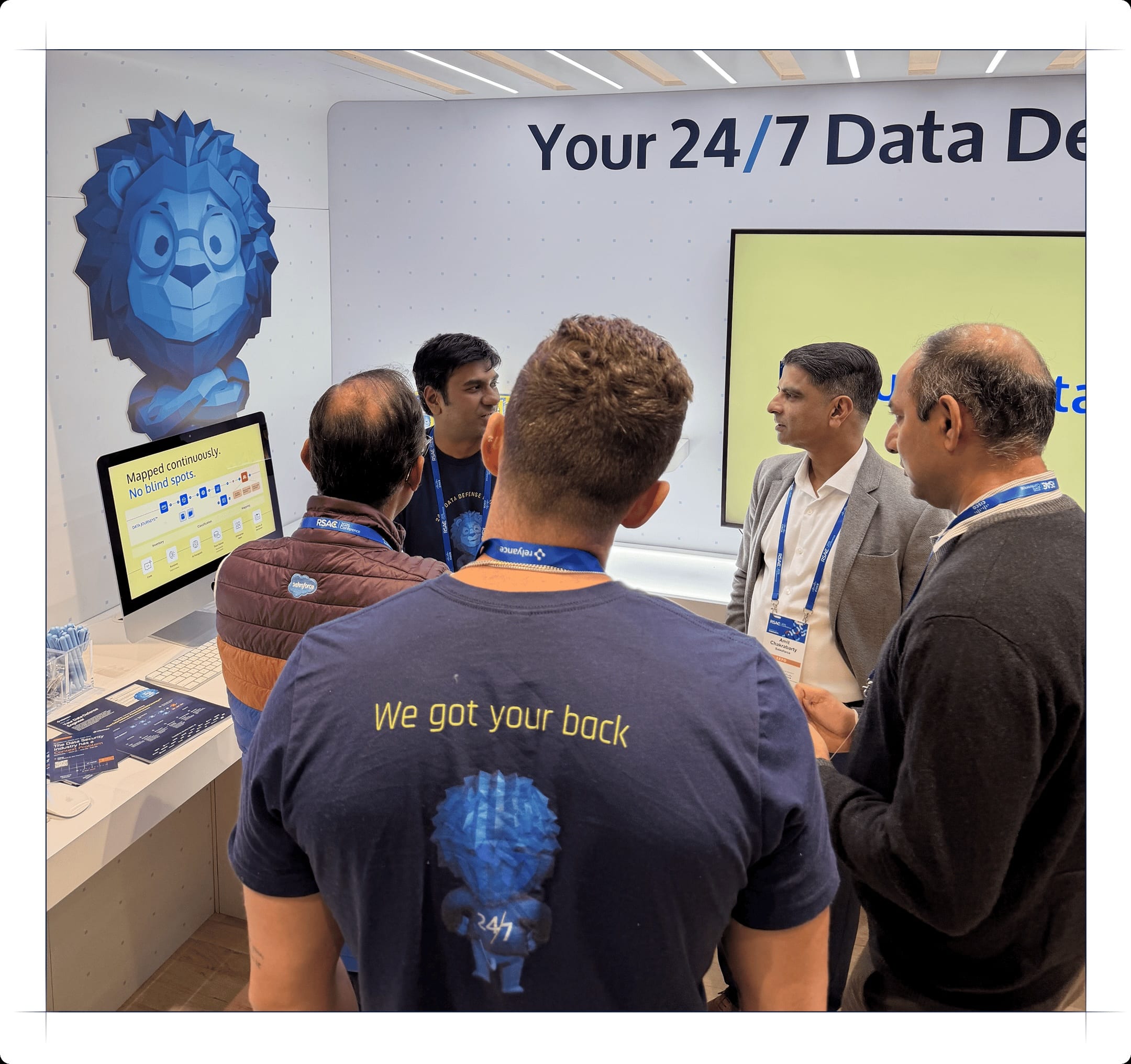
Vivek Bandyopadhyay, Sr. Forward Deployed Engineer, providing a live demo at  RSAC™ 2026 Conference

How Relyance AI can help

Our latest innovation, Lyo — our 24/7 Data Defense Engineer — directly addresses these needs by making risk intelligence immediate, continuous, and actionable. Lyo allows teams to ask natural language questions about their risk posture, where sensitive data is exposed, which identities have access, how data flows into AI systems, and receive instant, contextual answers powered by Relyance's unified graph of data, identities, and AI assets.

What surprised us most? Even mature security teams admitted they lack a unified view across data, identity, and AI systems, validating the urgency of our approach.

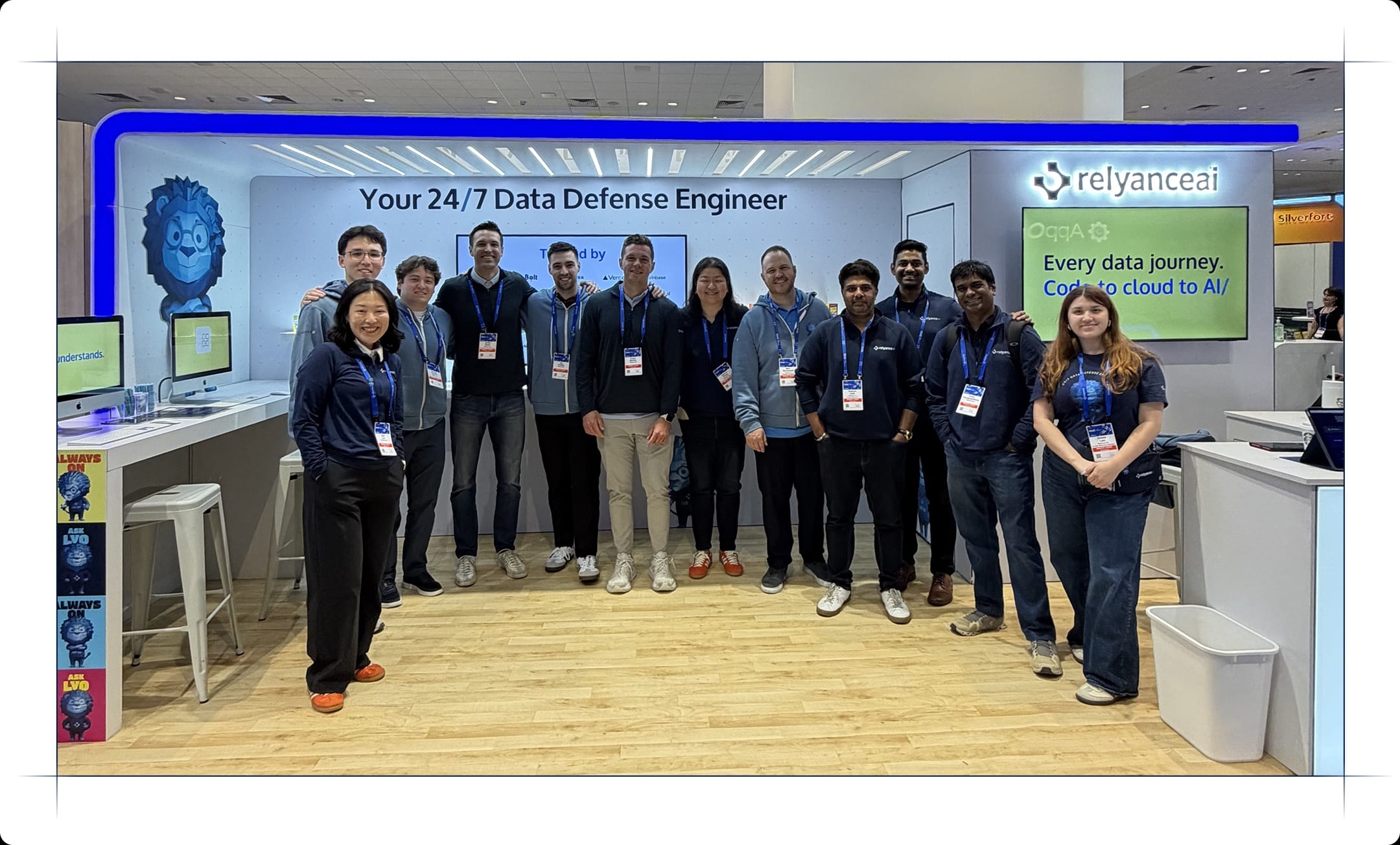
Entire Relyance AI booth staff team at RSAC™ 2026 Conference

From Insight to Action: Secure Your AI Stack Now

AI security starts with understanding your data. where it lives, how it moves, and where it's exposed. Relyance AI helps organizations eliminate blind spots, detect real risks, and respond instantly with confidence.

If you're looking to:

  • Gain full visibility into your AI data attack surface
  • Detect real breach paths across data, identity, and infrastructure

The next step is simple: connect with us to see it in action. Explore our platform, including Ask Lyo, and schedule a personalized demo to learn how Relyance AI can help you secure AI at scale.

You may also like

DSPM is the wrong abstraction. Here's what replaces it.

March 23, 2026
DSPM is the wrong abstraction. Here's what replaces it.

Introducing the 24/7 Data Defense Engineer: Why Posture Management Falls Short in the Age of Agentic AI

March 23, 2026
Introducing the 24/7 Data Defense Engineer: Why Posture Management Falls Short in the Age of Agentic AI

AI governance proves more important than ever at Gartner Data & Analytics Summit 2026

March 13, 2026
AI governance proves more important than ever at Gartner Data & Analytics Summit 2026
No items found.
No items found.