Data Journeys™: AI-Native, Real-time data protection
Real-time lineage and causality mapping to track dynamic data flow and security context.
Featured
The definitive guide to Data Journeys™ in the AI era

Board-Level AI Risk: What Directors Need to Know About Data Journeys

Graph-based data security: Why network analysis beats point solutions

AI Governance Frameworks: Why Existing DSPM Approaches Fall Short

Data Journeys: AI-native, real-time data protection

Data Journeys FAQ
What are Data Journeys and how do they differ from traditional DSPM?
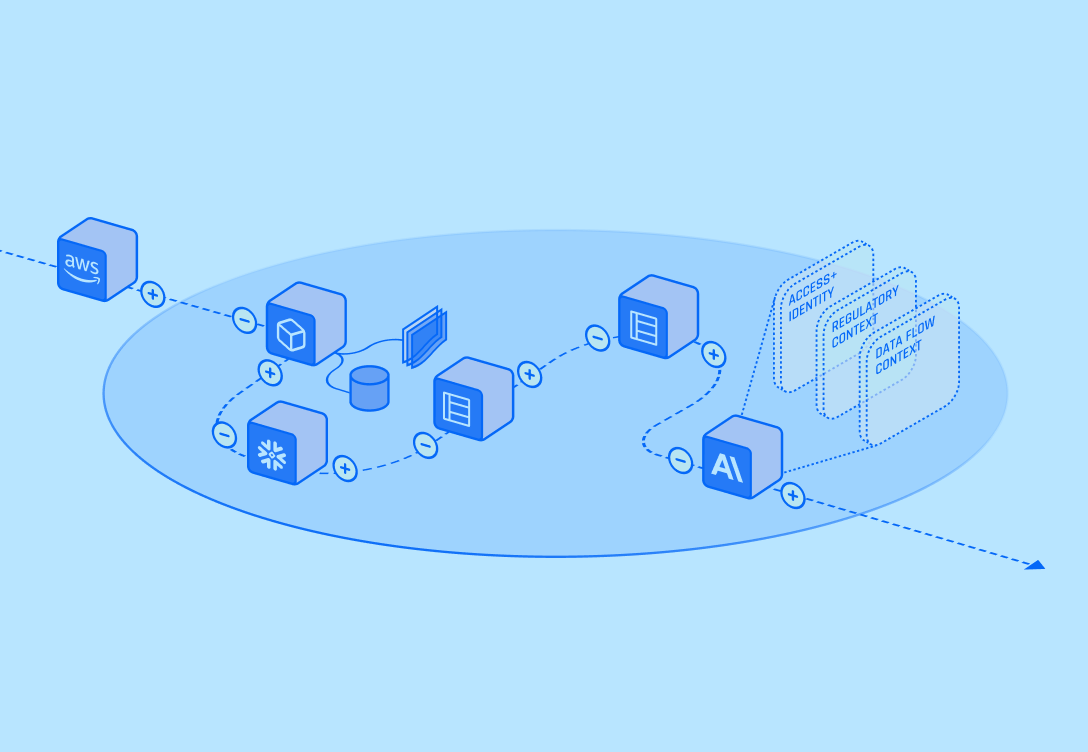
Data Journeys represent the evolution from static Data Security Posture Management to dynamic, AI-native data protection providing continuous real-time visibility into how data moves, transforms, and interacts across technology ecosystems. Unlike traditional DSPM tools analyzing data at rest during periodic scans—essentially taking snapshots of data landscapes—Data Journeys create live movies of data ecosystems showing every interaction, transformation, and decision point as it happens.
They operate on three core principles:
- Event-time lineage capturing data interactions as they occur (not when batch processes run).
- Causality mapping proving actual relationships between data events (not statistical correlations).
- Context preservation maintains business purpose and compliance context throughout transformations. This delivers definitive answers about data movement with complete audit trails.
Why can't legacy DSPM tools handle modern AI workloads effectively?
Legacy DSPM tools designed for traditional enterprise architectures cannot handle AI workloads because modern AI creates fundamentally different data patterns. AI models consume and generate data continuously rather than in batch windows, data meaning changes based on AI model interpretation and business logic creating contextual transformations, data fragments across microservices, containers, and serverless functions in distributed processing, and AI systems move and modify data without direct human oversight through autonomous decisions. For example, in AI-powered customer service systems, traditional DSPM detects customer data in databases but cannot see how AI models transform customer intent into insights, which specific fields influence model decisions, when models access data for training versus inference, how data moves between microservices during real-time processing, or whether AI outputs contain sensitive information requiring protection—creating compliance risks and security vulnerabilities.
What measurable business value do organizations achieve by implementing Data Journeys?
Organizations implementing Data Journeys achieve measurable improvements across three critical dimensions:
- For privacy operations, they accelerate PIAs and DPIAs from weeks to days, provide defensible consent management with real-time preference propagation, automate DSR fulfillment shrinking timelines from weeks to hours, and eliminate manual data inventory through autonomous RoPA generation.
- For security operations, they reduce false positives by 90% through causality-based detection, enable data exfiltration detection with context-aware threat analysis, provide proactive shadow IT detection across code, cloud, and AI environments, and deliver breach blast radius analysis with forensic confidence evidence.
- For AI governance, they enable confident AI adoption through complete lifecycle visibility, shadow AI detection with automated validation workflows, AI data lineage connecting training data to runtime decisions, and AI regulatory mapping for EU AI Act and NIST compliance.